Trending today
Popular movies
Popular TV
Top rated movies
Trending today
Popular movies
Popular TV
Top rated movies
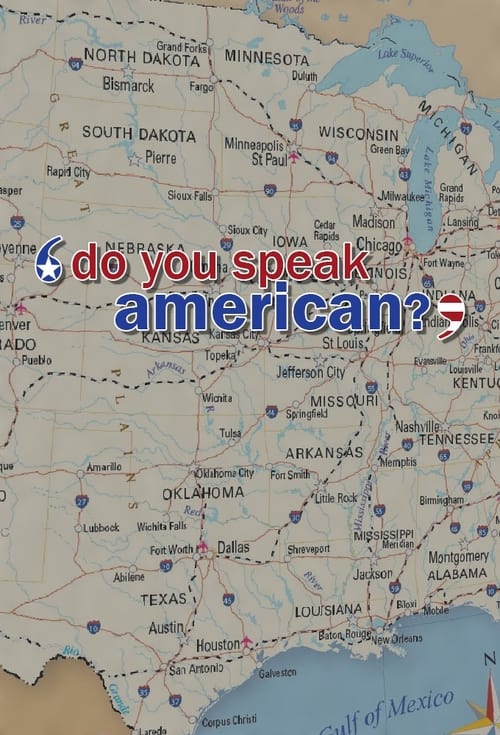
Why is the English spoken by Maine lobstermen so different from thatscene from the broadcast spoken by cowboys in Texas? Does Spanish pose a threat to English as the dominant language in America? And what on earth do yins, wickety wack, ayuh, catty whompus, and stomping it clean mean? Robert MacNeil travels cross-country to answer these questions and examine the dynamic state of American English – a language rich with regional variety, strong global impact and cultural controversy.
Jump into any season
First episodes — open an episode to play
Episode 1
MacNeil’s journey begins in Maine and winds around to Detroit after stops in Boston, New York, Philadelphia, Pittsburgh, Ohio, and South Carolina. Along the way, he meets lobstermen who fear their unmistakable New England accents may be dying out. In New York, the series samples the power and energy of words generated by Wall Street and the worlds of advertising and publishing. John Simon, theater critic for New York magazine, and Jesse Sheidlower, principal North American editor of the Oxford English Dictionary, express their opposing views on the future of the language, while local teens translate the jargon of Instant Messaging. Linguist William Labov reveals that, years ago, a British accent was the mark of prestige; now that prestige has less currency. On a train to Pittsburgh passengers are asked to identify the areas of the country where people have the “best” accent today. On the islands off of South Carolina’s coast, African-influenced Gullah and Geetchee sound so different from Standard English that the film employs subtitles. In Detroit, a hip-hop crew exemplifies a new trend, and the story of three boys involved in an important 1979 court case underscores the danger of stereotypes based on non-“standard” speech patterns.
Episode 2
Do You Speak American? heads into the Deep South for a look at Appalachian and “hillbilly,” shaped by the Scots-Irish English of early frontier settlers like Daniel Boone and Davy Crockett. Footage of the legendary North Carolina storyteller Ray Hicks, who died in 2003, captures a prime example of the dialect, and in Rabbit Hash, Kentucky, “country talkin’” seems to be alive and kicking.MacNeil gets a first-hand glimpse into the world of CB radio thanks to Spanky the Trucker, whose nephew, the country singer Cody James – an Oregon native – discusses how speaking “country” had become a national trend. During a performance in front of a packed house, the popular stand-up comedian Jeff Foxworthy imparts the meaning of words like manaze (pronounced “may-naze”) and witchudidga (pronounced “witch-uh-did-yuh”). Then, it’s on to the bayou for a night of traditional dancing at Fred’s Lounge in Mamou, Louisiana, where owner Tante (Aunt) Sue speaks English smothered in Cajun overtones. At a barbecue on the Bar J Ranch outside of Beesville, Texas, cowboys recite their poetry and point out the Spanish roots of words like bronco, stampede, corral, and rodeo. Songwriter and novelist Kinky Friedman, a “professional Texan,” talks about cattywhompus and larrupin, and in Austin, journalist and commentator Molly Ivins sits down with MacNeil to share her thoughts on true Texan English. Finally MacNeil investigates the controversy created by the town of El Cenizo, Texas, which has adopted Spanish as its “official” language.
Shows with a similar vibe
Because you viewed this